
Compliance Enablement Technology
That Holds Through Cyber and AI
When Workflows Accelerate, but Evidence Cannot Be Reconstructed
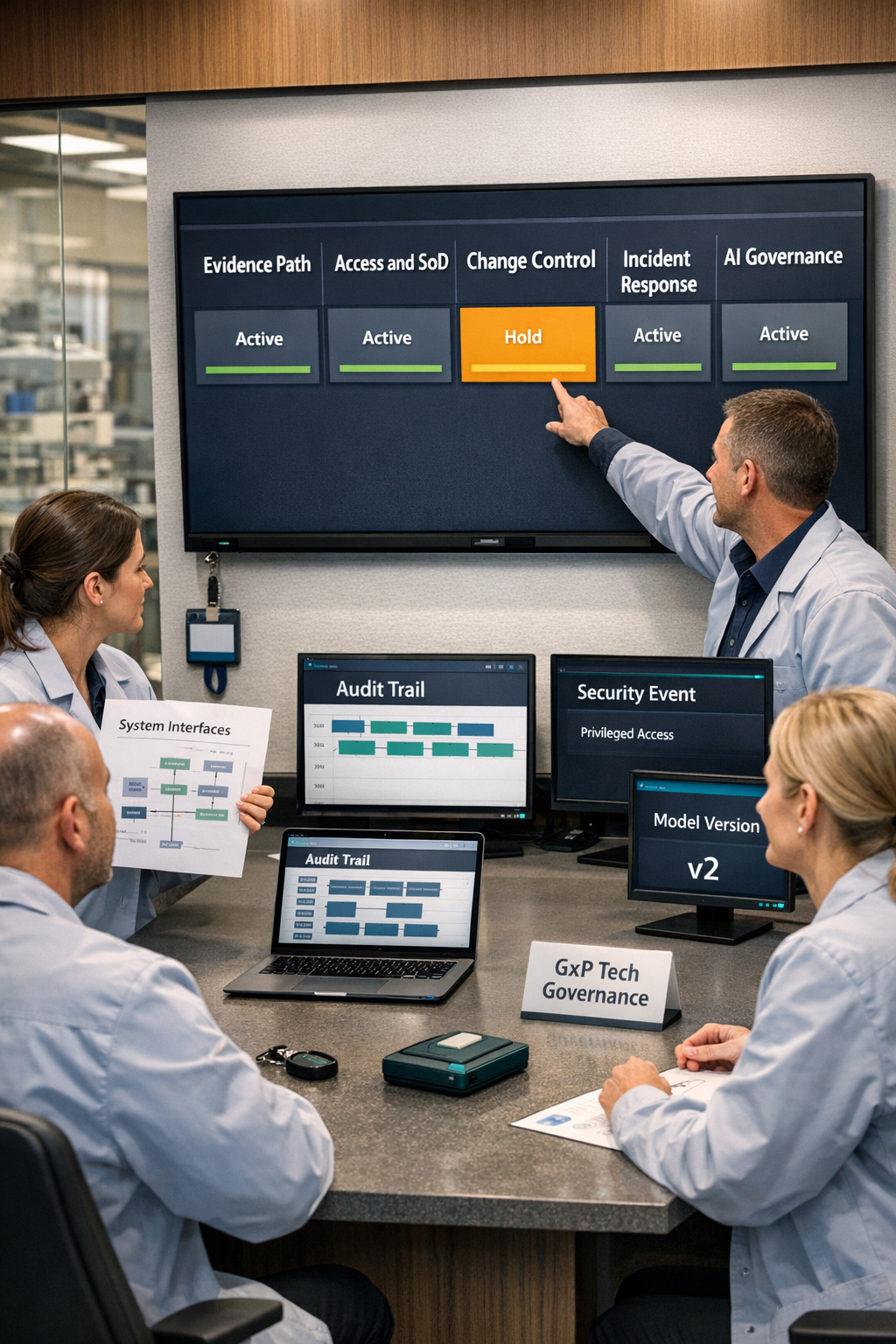
Compliance enablement breaks when the operating reality becomes a mesh of eQMS, MES, LIMS, RIM, cloud services, and supplier portals, but accountability remains trapped inside single systems. Global health authorities and notified bodies look for a continuous chain from signal to decision to action, including who had access, what changed, what data moved, and what the organization relied on at the moment a decision was made. The gaps usually live at interfaces and exceptions: identity and privilege drift away from quality roles, audit trails cannot be reviewed end-to-end, and configuration or patch changes move faster than validation and risk-based impact assessment. Cyber incidents then become quality events because emergency actions and degraded operations cannot be reconstructed into a defensible chronology. AI raises the stakes further when models influence triage, prioritization, or disposition without defined intended use, lifecycle governance, and monitored performance tied to change control.
How It Shows Up
- Role and privilege models diverge across systems, sites, and suppliers
- Audit trails exist, but cross-system review and reconstruction breaks down
- Data lineage fractures at interfaces, middleware, exports, and re-entry workarounds
- Configuration, patches, and SaaS releases outpace validation state and impact assessment
- Cyber events trigger urgent access and workflow changes without a recoverable timeline of actions and dependencies
- AI-assisted triage shifts priority and closure timing without intended-use boundaries, human review rules, and drift thresholds
What Compliance Enablement Must Govern
- Intended use, validation posture, and release gates across GxP platforms and integrations
- Identity, access, and segregation of duties aligned to quality roles and outsourced execution
- Data integrity across capture, transformation, storage, and reporting, including interface and export pathways
- Change governance for configuration, patches, cloud releases, and integration updates with documented risk impact
- Cyber lifecycle linkage to quality work: vulnerability intake, SBOM/SOUP oversight, incident actions, and recovery execution
- AI decision support boundaries: approved use cases, accountable human decision rights, model change control, and drift monitoring triggers
Compliance Enablement, Defined by Decision Provenance
Compliance enablement is the operating discipline that makes digital execution reviewable end-to-end: not a tooling rollout, but a governed way of working where quality decisions can be defended across systems, sites, and third parties. It aligns workflow design with validation intent and data integrity so record history, access, and data lineage remain coherent through integrations, exceptions, and high-velocity change. For global health authorities and notified bodies, the test is practical: whether the organization can demonstrate that roles, evidence, and approvals remain consistent as platforms evolve.
Cybersecurity and AI change the bar because both can alter the reliability of the record and the legitimacy of the decision. Cyber events introduce urgent access, configuration shifts, and degraded operating modes that must still yield a credible chronology. AI introduces automated prioritization and disposition pressure that must stay inside defined intended use, with explicit decision rights and monitored performance tied to change governance. PHALANX8 builds that convergence into the operating model, then verifies it through audits and investigations that target the seams where breakdowns typically originate.
When Incident Response Rewrites the Record
Cyber response becomes a compliance problem when recovery work changes access, data flow, and system behavior faster than the organization can later reconstruct what happened. Temporary privileges expand, remote vendor access is granted, integrations get bypassed, hotfixes land, data is exported and re-entered, and operational workarounds persist past restoration. Regulators and notified bodies then test whether the organization can replay the event as a defensible chronology: who did what, on whose authority, what data was impacted, which GxP decisions were permitted during degraded operation, and how the post-incident state was reconciled back to validated intent. AI raises the stakes because routing and prioritization engines can keep moving work while reliability is compromised, or quietly shift outcomes after a model or parameter update, leaving the decision trail harder to defend than the outage itself.
What Cyber-Resilient Enablement Must Withstand
- Emergency privileges that are time-bound, approved, and attributable to named decision rights
- Remote third-party access that is constrained, monitored, and tied to defined response playbooks
- Hotfixes, configuration changes, and integration bypasses that remain traceable and reversible
- Data movement and record handling during containment and recovery that stays attributable end-to-end
- Degraded-mode decision guardrails that define what can proceed, what must pause, and what requires escalation
- AI-assisted routing and prioritization that is gated during instability, with version control and defined drift triggers
- Post-incident reconciliation that closes gaps in chronology, restores alignment to validated state, and feeds CAPA with clear scope and ownership
How Remediation Breaks by Operating Model
- Compliance enablement architecture linking processes, platforms, integrations, and accountable decision owners
- Evidence pathway design from signal intake through decision, action, and verification across system boundaries
- Data integrity and lineage assessment for interfaces, transformations, exports, and re-entry workarounds
- Identity, access, and privilege design including segregation of duties, emergency access lanes, and third-party access constraints
- Change and release governance pack for configuration updates, patches, cloud releases, and integration modifications with risk-based impact logic
- Cyber event execution runbook integrated to GxP operations covering containment actions, degraded-mode decision limits, recovery steps, and post-incident reconciliation
- AI use governance pack for decision support defining intended use, human decision rights, review points, version control, and drift thresholds
- Targeted audits and investigations that validate cross-system replayability during exceptions, outages, and high-velocity change
Deliverables That Make Digital Quality Work When Conditions Shift
PHALANX8 delivers implementation-grade packages that align computerized system expectations, data integrity, cybersecurity execution, and AI decision support into a single, coherent operating model across sites and outsourced partners. The result is a replayable chain of accountability through releases, integration changes, and incident recovery, where authorities and notified bodies can follow decision rights, access, data lineage, and verification outcomes without gaps at handoffs.
How PHALANX8 Engages
PHALANX8 is engaged when technology change velocity outpaces the organization’s ability to explain decisions with a complete digital fact pattern. Typical triggers include eQMS or ERP modernization, new integrations and data pipelines, cloud platform releases, increased reliance on SaaS and managed services, and AI that begins to influence intake, prioritization, or workflow routing. The signal is not a lack of activity. There is leadership uncertainty about who had access, what changed, what data moved, which systems participated in the decision, and whether the record can be replayed coherently across sites and third parties.
Engagements convert a toolchain into governed execution that holds through releases, incidents, and outsourced touchpoints. Work centers on decision rights, access and privilege discipline, data lineage across interfaces and transformations, and change governance that links validation posture, cybersecurity execution, and AI use boundaries. When incident response or enforcement-adjacent conditions materially shape execution, PHALANX8 designs the work so containment and recovery actions still yield a reviewable chronology and a clean bridge to CAPA, verification, and ongoing monitoring.
01
Reconstruct the Evidence Path End to End
PHALANX8 maps how signals enter the organization, how decisions are made, and how actions are executed across platforms, integrations, and vendors. The work isolates failure points that break replayability, including interface transformations, export and re-entry workarounds, identity drift, and release practices that change system behavior without a clear risk impact narrative.
02
Define Decision Rights and Access That Match Execution
PHALANX8 establishes role-based decision ownership and access discipline that reflects how work is actually performed across sites and outsourcing models. This includes segregation of duties, privileged-action governance, emergency access lanes, and third-party access constraints that can be defended during outages, support events, and accelerated release cycles.
03
Govern Change Velocity Across Configuration, Releases, and Integrations
PHALANX8 implements a change governance model that treats configuration updates, patches, cloud releases, and integration modifications as quality-relevant changes. The focus is practical: what must be reviewed, who must approve, what evidence must be retained, and how cross-system impacts are assessed so the post-change state remains traceable.
04
Bind Cybersecurity Execution to GxP Decision-Making
PHALANX8 connects vulnerability intake, incident actions, remote support activity, and recovery steps to the GxP workflows they can affect. The outcome is a defined degraded-mode operating posture, with explicit limits on what decisions can proceed, what must pause, and what must escalate, plus post-incident reconciliation steps that close chronology gaps.
05
Govern AI as Decision Influence, Not a Feature
PHALANX8 defines approved AI intended use, human decision rights, review points, version control, and drift triggers for any model that influences prioritization, routing, investigation direction, or closure timing. AI changes are treated as governed change, with monitoring that detects performance shift early and escalation logic that routes work back to human control when thresholds are crossed.